When words have depth
Yesterday I procured a vintage Royal portable deluxe typewriter for an acquaintance that has concluded that he too wishes to correspond via typewritten missives. He has been looking for a manual machine in his home of Petaluma, without success for some time.
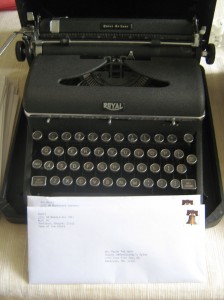
Royal portable quiet de luxe, destined for Petaluma after an oil bath and ribbon replacement at Ace Typewriter here in Portland.
Ace Typewriter — a great shop for typewriter service in Portland.
This morning I typed out a greeting message to my friend on his new machine, then completed a full letter on my workhorse desktop, a cosmetically damaged and incomplete but reliable Woodstock. On the second page of my letter I hit a patch of dry ribbon. Consequently, the imprint began to fade, my words dematerializing like a departing ghost. It occurred to me that words on the page not only have weight, they have depth. That is: they convey extratextual artifacts of their creator; a historical signature of the moment of their creation and clues about the writer. I recognize that when I’m anxious, angry or simply over caffeinated, I strike the keys with such vigor that the periods perforate the paper. [1] In moments of inspiration I am less likely to correct transpositions, confident that my reader or copy-editor will excuse minor errors or that I can correct them after completing the page. These artifacts give the text depth and are inseparable from the materials of the medium.
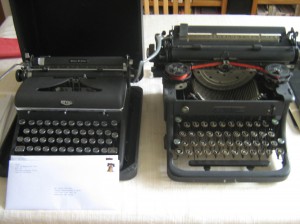
Sibling machines from the late 1940’s which will type correspondence originating in Petaluma and Portland
E-mail forwarded and “re”tweets are indistinguishable from their originals because of perfect digital duplication. There is no corporeal component to the text. Words are massless, without history. They may have a provenance encoded in hidden ISP data or transmission records, but to the reader the text is the ethereal, without history. It is lifeless: denied origin, destination or demise.
With the progress of voice recognition software, I wonder if dictation will soon replace keyboard entry. [2]If so, it will represent the triumph of the conversational over the compositional. On the other hand, perhaps it would inspire a renewed passion for oratory and rhetoric. Salons and debate societies could be reinvigorated. High school forensics might become as popular as athletics. A new TV series of following the trials and tribulations of a dozen misfit adolescent students struggling on a rural high school debate team entitled Rebuttal might even eclipse the hit GLEE…
I’m pitching this to my agent tomorrow.
- [1] I was chastised as a student for pounding the keys, a habit I’ve been unable to modify even after 20 years use of computer keyboards. My computer stroke is nearly as percussive as my manual typewriter work. ↩
- [2] I always found the literary and cinematic depictions of the office professional dictating to a secretary endowed with stenographic skills and shapely calves implausible. It’s also a strange quasi-sanctioned “performance”, an erotically charged form of storytelling which recalls both Homeric recitation and childhood bedtime stories. It seemed to me that extemporaneously composing formal legal correspondence would be absurdly haphazard and inefficient. I suppose the secretary couldn’t just type the dictation due to noise and because it would preclude verbal revisions – imperious and dramatic utterances such as, “strike that last sentence.” Nevertheless, I find it hard to accept this was ever a widespread practice. Surely today even our vastly overpaid CEO type their own e-mails. ↩